
On our second day in Israel we took a full day tour to Massada, a Roman fortress of immense importance to the Jews on a mountain overlooking the Dead Sea. Jerusalem is at an elevation of about 2500 feet above (Mediterranean) sea level but our initial destination today was the lowest place on earth – the Dead Sea, at1400 feet below sea level. So, in a distance of less than 20 miles we descended about 4000 feet on a well-paved divided highway.
We were now in the West Bank (of the Jordan River) and in an area that has been the center of conflict between Israel and Palestine for decades. There are three defined areas to the West Bank (although the boundaries are much convoluted – and often disputed); one entirely under Israeli control; one entirely under Palestinian control; and a third, essentially within greater Jerusalem, that is under joint administration. Our guide was quick to point out that our entire day would be spent in the Israeli controlled region and would therefore be safe!
Although Jerusalem itself has many lush areas and is surprisingly green and filled with decorative flower beds and parks, we were now in true desert – almost barren, rock covered and hot! Even here, however, there were green areas along what were now dried river beds and there is sufficient rainfall at the higher elevations to create seasonal flooding and sufficient irrigation to support a number of farms and kibbutzim. The overwhelming feel, nevertheless, is that of a mountainous, rocky terrain which borders a large inland lake – the Dead Sea.
The Dead Sea is fed only by the Jordan River, which is now so heavily dammed and depleted of water for upstream farming and industry that the Sea level is dropping at an alarming rate of about 3 feet per year. The water level has dropped so much that the lake is now in two parts and a project is underway to “refill” the Dead Sea with waters from the Red Sea to the south. A joint Palestinian, Israel and Jordan agreement will build a canal (actually just a pipeline) with the hope of maintaining, or even adding to, the water in the Dead Sea. It is interesting to note that the water flowing northward will actually be brine (from a desalination plant) in order to maintain the mineral level of the Dead Sea and preserve its health attributes and its tourism.
A “swim” in the Dead Sea (after an appropriate covering with therapeutic mud) was scheduled for the afternoon of our visit (we chose to decline, having performed this ritual several years ago only a few miles away in Jordan) but first we went to the site that had caused us to take this tour. This was the ancient Roman fortress city of Massada, occupied and made palatial by King Herod when he was puppet king during the Roman occupation. It was built on top of, and terraced down from, a mesa-like hilltop 1300 feet above the Dead Sea.
During the first of the Jewish-Roman wars, Jewish rebels – the Sicarii – overthrew the Roman garrison and were further supplemented by more Sicarii after the second temple at Jerusalem was destroyed. In 73AD the Roman Governor decided that it was time to take back the fortress and laid siege from several (still obvious) encampments surrounding the hilltop.

Model of Massada Fortress and Palace
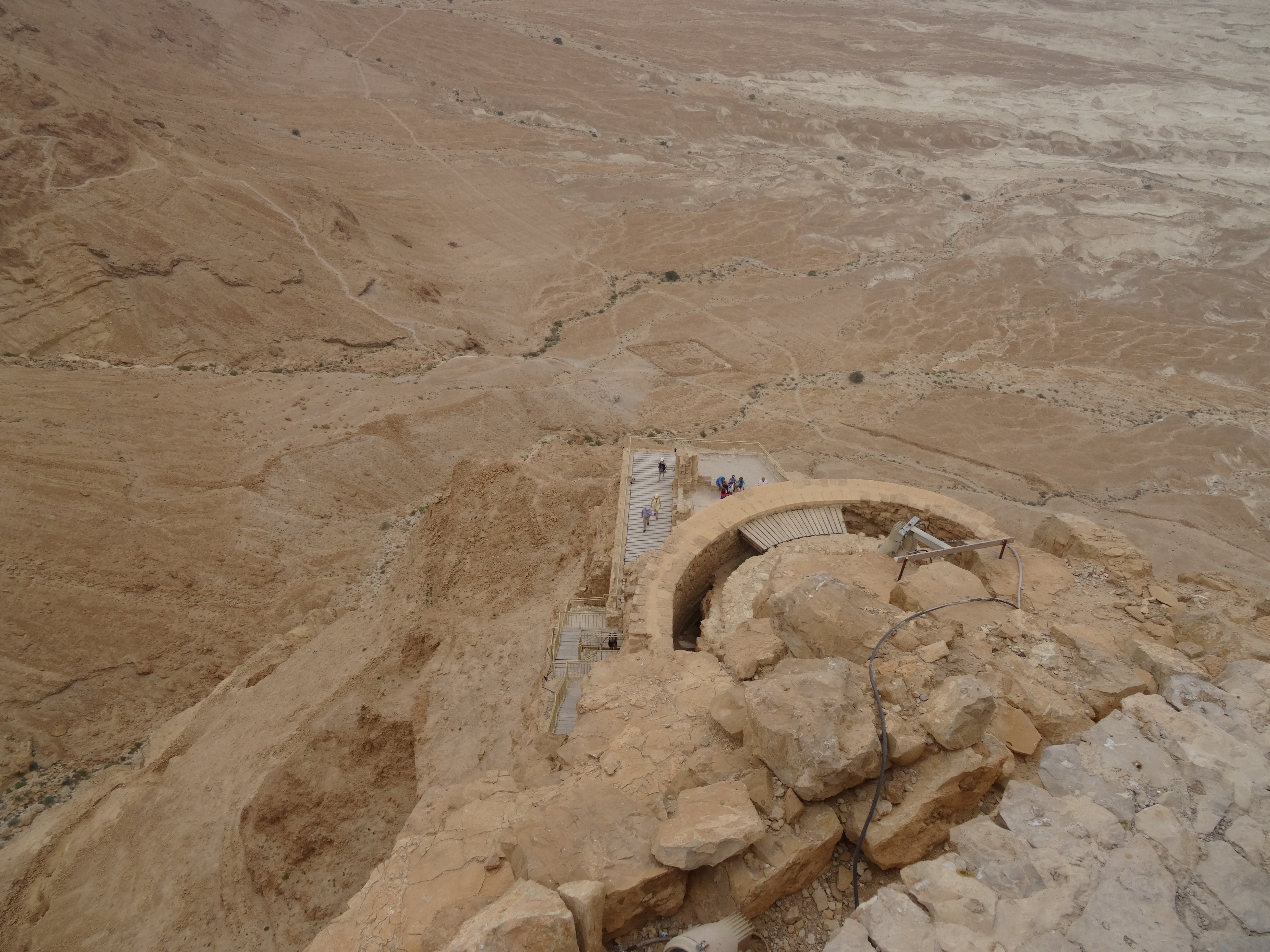
Massada today
Eventually an enormous ramp was built by the Romans and designed to allow troops to storm the fort at wall level. The Jewish Zealot occupiers realized that they were about to be beaten but rather than surrender to the Romans they chose to “surrender to God” and kill themselves. Of the almost 1000, ten were selected to do most of the killing and then were to kill themselves in turn. This apparently happened and was later confirmed and recorded by a few women and children who had hidden throughout this mass killing and later surrendered to the Romans.
In addition to being a legendary site of martyrdom, the fortress and palace were magnificent examples of Roman architecture and art and were as impressive as many other examples throughout the Empire. Even today there are clear examples of the traditional bathhouses, cisterns, mosaics and frescos typical of the advanced civilization of the time.

Roman underfloor heating in bath house

Roman fresco
Although it is possible to walk up to the fortress via a “Serpent Path”, we were fortunate that a 3000 feet cable car ride is available today and that was the approach we selected (as well as for the descent after our visit). We spent about two hours wandering the ruins and trying to picture the area as it had once existed. To this end there were several excellent models showing not only the overall complex but also depicting specific buildings, complete with columns and mosaic floors. As an archeological site it is certainly impressive and is made all the more interesting as a historically important example of the Jewish Faith.
The late morning on the mountain was a little overcast and there was a slight cooling breeze at that elevation. During the following two hour visit to the Dead Sea resort, however, the skies became clearer and the breeze dissipated such that it was 100F in the shade where we spent most of the time while our fellow tourists dipped and floated in the warm waters – and the much hotter air.

Dead Sea bathing!

First cover yourself with mud and then float!
