Singapore, October 2014

On our first day in Singapore (Sunday) we took the subway to the riverside around Raffles Place and Clarke Quay. This is the area where Raffles landed and founded the city and is on the edge of the colonial district, with its fine architecture. It was interesting to see that there is yet more building taking place and it took us a while to get our bearings, despite the fact that it had been only 1 ½ years since our last visit.

DSC04878

Singapore River from Raffles’ Landing

This evening we went back to the same area for dinner at an Italian restaurant right on the edge of the water – where a cooling breeze made it comfortable.

On Monday we spent just over two hours in Chinatown, part of it in a torrential downpour. We were able to dodge most of the rain by visiting many of the tiny shops filled with enticing souvenirs and finished our stroll with a late morning coffee.

DSC04885

Chinatown

DSC04897

Hindu Temple

On Tuesday we took the subway to Little India and walked the length of the main street there. We saw a couple of Hindu temples, one of which we went in and viewed the magnificent decorations. Lots of people were inside as this is festival time for Hindus.

DSC04909

The Sultan Mosque

We also visited Mustafa’s department store, an institution in Singapore, which seemed to be bigger than ever. There are five floors in two huge buildings and each is crammed with goods of every description. We walked from there  to the Muslim Quarter to view the Sultan Mosque. It then started to rain a little so we made our way to the nearest subway station and back to the hotel – by which time the usual early afternoon storm was in full swing.

For our final sightseeing day in Singapore we went to Marina Bay and visited the new Garden at the Bay complex. This is a huge plot of reclaimed land (just filled in on our first visit in 2000) on which a large garden area has been laid out in park-like fashion. The outdoor area is very nicely presented with broad walkways and beautiful gardens (Chinese, Indian, etc), although walking in the full heat of the day is not recommended! However, the highlight of the new area is a two glass-domed complex under which are plants, trees and other flora from many different areas of the globe, all presented in very natural surroundings. And it is completely air-conditioned throughout! It is similar in concept to the Eden Project in England but done in a manner that seems to fit this fantastic city.

DSC04927 DSC04959


Tomorrow (October 30) we head for home!


Permanent link to this article: http://tykesabroad.com/singapore-october-2014/

Myanmar: Yangon (Rangoon)

Wednesday October 22

Today was spent almost exclusively on a bus! The drive from Pyay to Yangon was only 190 miles but took the best part of eight hours. The “Highway” (one of the major arteries in the country was a two lane road (barely wide enough for two buses to pass without inching on to the dusty berm) and was an almost continuous stream of traffic even away from the towns and villages. In those more residential areas it was even more chaotic with buses (lots), trucks, motor bikes, bicycles, tuk tuks (and variants), oxen, cows, goats and people!

We made a total of three stops, the last of which was at a Commonwealth War Graves cemetery. It was very similar to the one Molly and I had visited in Normandy some years ago where we found her father’s name on a stone pillar (designed for those whose bodies were not found or identified); so much so that for a few minutes we just stood there and cried together and it was a somber ride for a while once we got going again.

We arrived in Yangon and fought the rush hour traffic to arrive at the Shangri-La hotel around 4:30pm. Just the relatively short drive through city streets showed us how much more Western was this city when compared with the rural areas we had already seen and even with the larger towns of Bagan and Mandalay. Skyscrapers (not generally more than about 20 floors), brick and stone built houses and apartment blocks and modern shops – very much like other large Asian cities. And the difference in dress was quite startling; yes, the longi was still in use but alongside mini-skirts, jeans, shorts and other Western clothes. Presumably this is a taste of the future here; inevitable, it seems, but desirable????

We had no formal program on Thursday morning so we had a leisurely breakfast and then went a couple of blocks to a local market. It was full of souvenir stalls, many jewelry and precious stone outlets, paintings and wood carvings of every description. All were lovely to look at, tempting to buy – but we were very conservative as we have many examples of similar works at home already.

Our afternoon excursion began at 3pm. This took us first the center of town (very close to the hotel) where we saw the old city hall a very nice square with fountains and a very nice old colonial red brick building. There was also a Baptist Church, a mosque and (of course) a Buddhist Temple within the same area.

DSC04784

City Hall, Yangon

DSC04778

Downtown Yangon


Then we drove to a very pleasant park in which there was a large lake and a replica of a royal barge. This is now a restaurant but it is ornately decorated and presumably a faithful copy in all respects.

DSC04799

The main attraction today, however, was the largest pagoda (Schwedagon) in Myanmar, perhaps even in the world. An elevator took us to the terrace (itself perhaps 150 feet above street level and the pagoda itself rose a further 362 feet from there. It is completely gold in color with parts done in gold paint, some covered in gold leaf and even some parts which are claimed to be solid gold. We were told there were over 40 tons of gold on the building. It is also believed that there has been a pagoda on this site for 2500 years (making it the oldest in the world) and inside are cuttings from the hair of Buddha. The top spire contains many jewels including a huge ruby.

DSC04843

The 362 feet high pagoda

DSC04852


DSC04839

Reclining Buddha

DSC04855

The “Monday Corner (Tiger)”

It is impossible for me to describe the other features on the terrace itself. There are several Buddha images, dozens of shrines of all sizes and small shrines representing the days of the week. Buddhists are big on astrology and the day of one’s birth is important to all kinds of union – from business to marriage. Actually there are eight days because Wednesday is represented by two elephants – one with tusks being the morning, the other (without) being the afternoon.


The overall impression on this terrace with its huge central pagoda is that it is a jewel of white (marble) and gold. There are other colors of course, but these two predominate and give the sense of opulence and beauty that is overwhelming. Many in our group mentioned that, had we taken the tour in the other direction, with Yangon and this pagoda being on the first day in Myanmar, everything following would have been a let down. I am not convinced that the rest of the country that we saw could ever be a disappointment no matter the sequence, but this was certainly a major highlight of our visit.

DSC04840

Part of the Terrace – a study in white and gold

On Saturday our tour concluded with the return flight to Bangkok and an overnight stay there. Molly and I continued on to Singapore for five days of relaxation in a city we have visited many times before.


Permanent link to this article: http://tykesabroad.com/myanmar-yangon-rangoon/

Myanmar: Sailing towards Yangon

Monday (October 21) was one spent mostly on the ship except for a 1 ½ hour shore excursion to the village of Thayetmyo. This had been a frontier post town in the early years before all of Burma was under British rule so we were now in the Lower Burma of old. The fort is no longer here and there is no real evidence of its former importance.

Our primary reason for the stop was to visit a middle school with an enrollment of 300 children. As we approached the school the kids (all in green and white uniforms except for about a dozen in traditional Burmese dress) formed two long lines between which we passed. As we walked into the main hall of the school the children bowed and said – in excellent English –“Hello; welcome to our school; we are glad you are here”, a chant that they repeated in unison until everyone was seated.

DSC04634

Welcome to our school!

DSC04632

The traditional dancers


We were then given a performance by about twenty of the children; two traditional dances and one rather Western-style mime of a boy trying to court a young lady – and eventually succeeding! The traditional dance, with the girls in long dresses with “tails” was very good – better than a similar performance that we had seen earlier on the trip by “professionals”.

It is amazing to see how well educated the children are and how clean and well-dressed they are. In a country where there are few paved roads and mud and/or dust is underfoot at all times, and where bathing in the river is commonplace, it is humbling to see just how well they present themselves.

Although we have one more night after this on board, tonight was our farewell dinner at which we were encouraged to dress in traditional Burmese fashion and learn some Burmese dancing. It was more fun than it sounds!

On Tuesday morning we had our final shore excursion in the town of Pyay. We visited the Shwe San Daw pagoda which was probably the most spectacular we have seen. There are 160 steps to the terrace (or an elevator is available) and the pagoda and its surrounding buildings are a mass of gold. Once again, we were amazed at the obvious expense of these places of worship, especially in surroundings that are far less opulent.

DSC04718

Shwe San Daw Pagoda

DSC04712

Absolutely enormous Buddha


We then drove to and archaeological site recently designated a UNESCO Heritage Site (Srikrettara). Here was a brick pagoda from the 5th century (Payagyi Pagoda), indicating a good deal of engineering skills in the country at that time. The actual “dig” site is unearthing a huge complex with surrounding brick walls – sometimes as many as three walls between the compound and the outside world. This had been a walled palace for a very rich king between the first and eighth centuries and the associated museum contained many artifacts from the period. Again these indicated a good deal of sophistication in terms of artisan and engineering skills with materials from gold and silver to stone and iron.

DSC04735

Fifth Century Pagoda


Then it was back to the ship for the final time. Tomorrow we drive to Yangon for our final two nights in Myanmar.


Permanent link to this article: http://tykesabroad.com/myanmar-sailing-towards-yangon/

Myanmar: Bagan and south

On the first of two days in Bagan we experienced one of the most magnificent sights certainly of this trip so far, possibly of any we have ever seen in the world we have traveled. We visited the Thapyinnyunt Temple and we climbed over seventy steps to a terrace from where we had a panoramic view of the Old Bagan area.

DSC04309 - Copy

Just one of 2000 temples, pagodas and stupas

DSC04322 - Copy

Panoramic View of Bagan

This ancient city, dating from the 11th century, at one point had over 4000 pagodas and temples, built by kings and commoners alike and in every shape, size and degree of decoration. An earthquake in the last century had destroyed or damaged almost half of these but we were still looking over a valley containing over 2000 teak or brick buildings.

UNESCO had started a major renovation here but the last military government eventually disagreed with their methods and/or interpretation and they were thrown out. Now the Ministry of Culture in Myanmar is working alone to maintain those that are left and perhaps re-build others. Clearly it is an enormous task and the guide suggested that the new government may invite UNESCO back to help.

In order to help the preservation process, all the people who had lived in the old city were removed to New Bagan, although they could maintain their small plots of farmland. The result for the visitor is a vast vista of clean, green area with these wonderful 1000 year old structures dotted throughout. At mid-morning, from the vantage point of the temple terrace this was a truly awesome sight – one that alone was worth the visit to Myanmar. As we have on so many occasions and in so many places around the world, we were amazed at the architectural and engineering skills involved in the construction of these temples – as well as at the cultural and spiritual level of the people who dedicated them, in this case to Buddha.

Our next stop was at the Ananda Temple, which is regarded as the masterpiece of Bagan. Here murals and frescoes inside the building are the main attraction. Many of the paintings (no photography allowed) lining the hallways and small rooms date from the eleventh century and the colors are remarkably bright and fresh to this day. Many have been cleaned, but we were assured that no additional painting has occurred so we were looking at 1000 year old art, much of which tells the story of everyday life of both royalty and commoner.

DSC04326 - Copy

The largest of the Bagan Temples

DSC04365 - Copy

Ananda Temple

Following lunch back on the boat, we had time to relax before our 4pm excursion to a lacquer ware factory (apparently concentrated here in Bagan) before viewing another temple (Manuha) and the Shwesandaw Pagoda for a sunset view across the city.
DSC04381

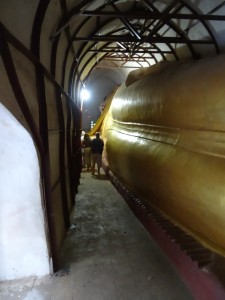
Enormous reclining Buddha

DSC04394

Sunset from the Shwesandaw Pagoda


On Friday we sailed further downstream on the Irrawaddy River making one stop in the morning to visit a local village and another late in the afternoon we stopped at a larger village called Saley, which we were told had about 500 families – relatively large for this part of the country.

DSC04467

Saley Monastery

DSC04447

Pagoda at Saley Monastery

Saley is home to several monasteries, temples and stupas, each beautifully decorated and painted and in good condition. How a group so small could afford to build and maintain such a range of buildings is difficult to imagine and it must be yet another example of the generosity of the Myanmar culture in this largely Buddhist country.

Saley is also home to a number of colonial homes and buildings and, for the first time since Mandalay, we saw architecture that would have been the image that I had of Burma before coming here. We visited one of these homes and, although significantly more Western than the bamboo homes prevalent in the countryside, it was still rather basic and somewhat bare. This may be a reflection of recent military government rulings or simply the end of the colonial era and its influence.

DSC04471

Colonial Home

DSC04500

More typical bamboo home


The ship set sail on Saturday morning from Saley but was docked again in Pha kha Nge village by 9am. We had an hour to walk through the village and meet several of the local people. It was interesting to see village life (especially on a Saturday when most people weren’t working) without the backdrop of stupas and temples. Not that these didn’t exist here (we saw dozens as we sailed away from the village) but they were not included in the tour. Instead we met the village pharmacist, the doctor, a school teacher and a mid-wife as well as three 80 year old sisters who came out of their home to greet us. Our guide said what we had already observed – Burmese people look either very young or very old; there appear to be no 40 to 60 year olds. They are there of course, but rapidly change from youthful to elderly so there appears to be no middle age.

Back on board we had a talk by one of the program directors on Myanmar Today, essentially covering the period of British rule (mid-1800s to 1943) and the subsequent Japanese occupation – which led to Post-War Independence. The period since then has seen various shades of democracy and, more recently, military rule. The latter allegedly ended five years ago but, as we were told, it was little more than a change of clothes from uniform to civilian and now the country is controlled by a few very rich ex-military who own virtually all businesses in the country.

All in all, things appear to be in a rather undisciplined state which will probably take a long time to change to anything we would recognize in the West. Despite that, the people seem very happy and, as the country opens up more to visitors and tourism, perhaps things will improve. Even today, electronic technology (cell phones, television, the internet) is ubiquitous so influences from other parts of the world are surely being felt.

We sailed for several hours in the afternoon and arrived in the city (400,000 people) of Magway in time for a late afternoon shore excursion. This was a tour of the city by trishaw (a bicycle with side car). The trishaw seems to be designed for two passengers but for us it was one to a bike; presumably our size and weight were enough for the (very fit) local who had to pedal.

DSC04523

Trishaw ride

We made a couple of stops, one to visit another pagoda, but otherwise we were driven around the city on the “bikes”.

DSC04560

Another beautiful pagoda terrace

DSC04574

Our ship at night


On Sunday morning, five monks came to the ship to bless it and its passengers and to go through a Buddhist service. It was interesting to watch but would have had more meaning if we had been given a better introduction to what the chanting and prayers were about. The overall sense, however, was that there were readings, a “sermon”, prayers and blessings – not at all dissimilar to a Christian service. The major difference would be in the offering; the monks were given robes, food for the day and money as part of the service, once again underscoring the reverence given to these men as well as the generosity of the people.

Mid-morning we were each given $1 in local currency and an assignment to purchase a given item in a local market – from vegetables to (in our case) shampoo. It was an exercise that we would not have chosen, but it turned out to be interesting; if not for making the purchase, certainly in getting the flavor of a real local market.

DSC04585

Market: plenty of fish for sale!


DSC04579

Time to do the washing and take a shower!


In the afternoon we sailed again for a few hours to dock at Minhla for a visit to a fort built to protect Royal Burma from British Burma. The architects and engineers were Italian. This was at a time (1860) when Lower Burma was ruled by the British but Upper Burma was still under the control of the Burmese Crown. The whole country did not come under British rule until 1880.

The fort is a substantial brick construction on two levels and had, on the ground floor, a total of 21 rooms for the 500 garrisoned there. The canon have been removed (we saw one outside the Royal Palace in Mandalay) but otherwise the fort must look pretty much as it did 150 years ago.

DSC04602

Fort built to defend against the British


Permanent link to this article: http://tykesabroad.com/myanmar-bagan-and-south/

Myanmar – Cruising the Irrawaddy from Mandalay

Tuesday’s excursions (October 15) were split – one beginning at 8:30 and the other at 3:30, with a three hour break for lunch and relaxation on the boat.

DSC04149

“Your carriage awaits!”

In the morning we were taken by bus to the Ada River, which joins the Irrawaddy (on which we will be cruising) here in Mandalay. Here we boarded a small ferry boat to take us across the relatively narrow crossing. There had been a heavy downpour (we are still in the monsoon season) earlier in the morning so the approach to the ferry was a little muddy. However, this was mild when compared with the inches deep mud that we had to negotiate on the other side as we made our way to our waiting horse-drawn cart! Each cart took two tourists (based on other modes of transportation we have seen, I suspect that at least 20 natives would normally be packed in) on a 15 minute ride through mud and water to the Mae Nu Oak Kyaung monastery.

DSC04153

Teak Monastery

This monastery is one of only a few built of brick rather than the more normal teak wood and had been built for the king (and his personal monk) when the capital of the country was here – approximately the 300 years preceding the move to Mandalay and the palace we had seen yesterday. It wasn’t clear whether the main building simply housed the king and his entourage when it was first built but it certainly was an impressive building. It was built on three levels (all Myanmar temples and other important structures are an odd number of storeys) and, when it was painted in its original pale yellow it must have been even more spectacular. Now it is blackened with the rain and humidity and only a few areas have been given an attempt at re-painting but apparently it doesn’t stand up very well.

DSC04164

The stupa near the monastery

From the monastery we walked to a nearby village where we saw the bamboo homes (and one or two “colonial” brick structures). The living quarters and infrastructure were very primitive (no electricity, a common well for water and who knows what for sewage) and we visitors would classify it as very poor or even uninhabitable. However, everyone seemed to be comfortable with their lot and it seems were well fed and clothed. Certainly the dozens of young girls trying to see trinkets and accompanying us the entire time) were very happy, had beautiful teeth and clean clothing (obviously their feet today were caked in mud – but so were ours!). One girl who latched on to Molly and I at the dock and rode behind the cart on her bike claimed to speak several languages and indeed said a few words that we recognized in French, German and Spanish.

DSC04173

A typical village home

Our afternoon excursion took us to Ananampura and a silk and cotton weaving workshop (emphasis on “shop”) and to the biggest monastery in Myanmar, Mahagandayon. This is a working monastery with 1500 monks on site so we were able to get a glimpse into their daily life. As was mentioned earlier, 85% of the population is Buddhist so it is as much a way of life as it is a religion. There are 850,000 monks in the country’s 60 million population and (although I am not certain on this point) I don’t believe that includes those (especially boys, but girls also) who serve some time (from weeks to years) as monks as part of their early life before joining a different workforce.

Actually, the monks are not strictly a part of the workforce as they hold no jobs (perhaps they do some tasks within the monastery) and twice a day they go “door to door” to be given donations of food for their two meals. Apparently many people (perhaps all?) prepare something for a monk as part of their own meal preparation and, indeed, set it aside, rather than giving the monk the “leftovers”. In the huge monastery we were now visiting, going out to get meal donations was not necessary as the locals provided donations directly to this important and prestigious place – which in turn is a major source of schooling for boys of all ages.

Our final stop of the day was at a small lake where we were taken out in rowboats to view the setting sun. Another feature of this area is a 1.2 Km teak bridge, built across the lake from the wood available as the capital was moved from Ananampura to Ada. It seems to be holding up very well after a few hundred years and was packed with tourists and locals alike. It was a very pleasant way to end another busy day.

DSC04218

Sunset boat ride with a 1.2 Km teak bridge across the lake

After the hectic pace of the first three days, Wednesday was much more relaxing. We had one short (but very hot) shore excursion to see terra cotta pottery being made using the traditional potters’ wheel methods and the rest of the day was spent relaxing as we cruised the Irrawaddy River to our next destination. The scenery was interesting but somewhat monotonous as the river is in the center of a huge flat plain where farming and fishing seem to be the way of life. The only color (other than green of the land and trees and the yellow sand bars) was provided by gold-domed pagodas which seemed to dot the countryside at frequent intervals.


On Wednesday we set sail from Mandalay down the Irrawaddy River to our next stop for two days in Bagan. On the way we made one stop to visit a local terra cotta pottery factory where everything was made by hand. Women worked in 100F temperatures and 80%+ humidity in the open air. We felt like we were in a sauna just watching the process and were thankful not to be there when they fired the clay in huge bonfires!

More from Bagan


Permanent link to this article: http://tykesabroad.com/myanmar-cruising-the-irrawaddy-from-mandalay/

Myanmar, October 2014


We finished our two days in Bangkok and flew from there to Mandalay for our first of 12 days in Myanmar. As our Bangkok guide said, we were leaving a country (Thailand) that has been under martial law since May of this year for one that has been under the same system for many years. However, as he also pointed out, we had not seen a huge military presence on the streets of Bangkok and we presumed that our experience would be similar in Myanmar.


The International Airport in Mandalay is small but getting through Immigration and Customs was straightforward and we were met by our local guide, Dorothy, who will be with us until we end the cruise. The initial impression of the country is that it is poor (much like most of India and Cambodia that we have seen) and housing for many can be quite primitive. It is only a few years since the country was opened up to the rest of the world and is clearly still in the early stages of development into a modern society.

50% of the population are farmers (rice, bananas, mangos, etc) and another large part of the economy is mining of precious stones.


Things are changing, however, and the cell phone is becoming ubiquitous, especially now that they have two commercial phone companies in addition to the government controlled service that existed alone until recently. We were told that this is an ideal time to visit the country while it still retains its character which must surely change as more and more visitors come and technology (not to mention McDonalds, etc) become as common as in other western and Asian countries.


DSC03946

Gold Leaf Buddha

After arriving, but before we were taken to our cruise boat, we were taken to the first of many temples that we will see here. This was the most revered Buddha temple in this part of the country, perhaps in the whole of Myanmar since it was reputed to have been in contact with Buddha himself in some former time. The “serene gold-leaf Buddha” is housed in the very ornate Mahamuni Pagoda. The shrine was well attended by the locals (85% of the country is Buddhist) who had, over the years, applied 20 inches of gold leaf to the figure and were still doing it today. Actually, only men are allowed close to the Buddha and women (including those in our group) had to view the figure from a distance. Nevertheless, men and women by the score were in and around the temple praying and otherwise paying their respect.

Once on the boat we were taken for a short sunset cruise along the river around our dock area to give us a wonderful introduction to Mandalay and Myanmar and its very colorful environment – especially as the sun was setting. We saw literally dozens of gold-domed pagodas, temples and other shrines.

DSC03961

This was followed by a good dinner on board and an after-dinner drink on the sun deck – in a raging thunderstorm! Our small group (Jay, Gordon, Molly and I) recognized this ship as the sister ship to the one that had taken us along the Mekong River in Cambodia and Vietnam almost three years ago. It is a little outdated in terms of amenities (bunk beds, relatively poor air-conditioning, etc but it is a very attractive wooden ship with a good deal of atmosphere befitting the region.

DSC04018

One of the 729 tablets

DSC04020

The “Biggest Book in the world”. Each housing contains one slab with writing on front and back

Monday was a hot, sunny day for a full seven hours of sightseeing in Mandalay.We first stopped at the Kuthodow Pagoda where there is a magnificent golden temple but which is more famous for the “Biggest Book in the World”. This is a series of 729 marble slabs (each in its own small housing) on which are written teachings of Buddha. The slabs date from the 17th century, are written in Sanskrit and each measure about 3 by 2 feet. We were told that to read the entire set would take six months chanting around the clock! Apparently only a relatively few monks can even read the inscriptions these days.

DSC04061

Teak Monastery

DSC04034

Gold Pagoda

DSC04031

One of dozens of Buddha images

DSC04107

The Grand Royal Palace

Then we went to the Shwenandaw Monastery which is decorated inside and out with amazing wood (teak) carvings – most of which were originally covered in gold leaf. These carvings are almost 200 years old and in remarkably good condition. The building itself was built for the king but he died there and it has been a shrine to him and home to a monastery ever since.

DSC04110

Another section of the Royal Palace

Then, after lunch, it was on to the Royal Palace. This was built for the monarch when he moved the capital to Mandalay in the 19th century but only two kings reigned from there before the British took over Burma and the second king was exiled to India. He had no sons and, although his queen did eventually return to Myanmar, it was basically the end of the monarchy in this country.

The palace, however, is enormous. Inside the wall, there are dozens of buildings which housed the royal family as well as reception and entertainment rooms for visitors to the palace. The main entrance hall is a gold covered building and many others are similarly decorated, one of which is essentially built in glass. The whole complex is lavishly decorated and carved and must have made a great impression on visitors as well as providing a very nice home for the royal family. Many of the buildings have been re-built after a fire destroyed a large part of the complex during World War II.

Finally today we went to the craft “factories” and, of course, their associated shops. This is a necessary part of any tour and usually designed more to separate you from your money rather than educate, but there is usually something of interest to see and viewing the working conditions is educational in itself.

DSC04066

One more golden Buddha image for good measure!

More to come,

Bob and Molly 


Permanent link to this article: http://tykesabroad.com/myanmar-october-2014/

Thailand, Myanmar and Singapore, October 2014

We are currently in Bangkok at the beginning of a visit to Thailand, Myanmar (Burma) and Singapore. The main focus is a river cruise in Myanmar but the tour starts and ends in Bangkok and we have chosen to add a few days in Singapore at the end.


We arrived in Bangkok (after a mere 28 hours from Cincinnati) on Thursday night (October 9) and move on to Myanmar on Sunday. We have been told that internet access in Myanmar may be poor so this may be the only Post we can make until we return to Bangkok on October 25. If so, bear with us; in the meantime we are including a few pictures of our time here.


Today (Saturday) we spent the morning visiting the Grand Palace. This is a huge site comprising temples and civic buildings and is the official residence of the king. The Palace was built over a 100 year period beginning in 1772, at the start of the current Rama Dynasty, and reflects the architectural desires of the first three or four kings. This was our third visit to the palace but each time we are amazed at the beautiful buildings and the extremely colorful decorations on them all. Orange and gold seem to predominate but all colors are represented since virtually all surfaces are covered with metal, ceramic or glasses of every shade.

The Grand Palace from the River

The Grand Palace from the River

The original palace building

The original palace building


The latest palace building

The latest palace building


Quintessential Thai architecture

Quintessential Thai architecture

The golden stupa

The golden stupa


Every external surface beautifully decorated

Every external surface beautifully decorated

The spiritual center of the complex houses the Emerald Buddha, a small figure dating from the 15th century and originally found in Laos. It is only about two feet high but is housed in a large, ornate temple, perhaps 50 by 20 feet and 40 feet in height.

The Emerald Buddha's Temple

The Emerald Buddha’s Temple

The civic buildings are equally impressive and stand in beautifully manicured gardens. Every building appears to be in immaculate condition and well maintained.

Wat Arun Hindu Temple from the river

Wat Arun Hindu Temple from the river

The city of Bangkok sits on the Chao Phraya River, which is filled at all times with water taxis, ferries, tourist boats and huge commercial barges. The overall impression is of a huge modern city (which it is) but spread throughout are examples of traditional Thai architecture in the form of temples, civic buildings and, of course, the Grand Palace. It is a beautiful city both day and night.

Bangkok by day

Bangkok by day

DSC03846

Bangkok at night


As we said, tomorrow we break new ground on our first visit to Myanmar. More from there………… or wherever we can “connect”.

Bob and Molly

Permanent link to this article: http://tykesabroad.com/thailand-myanmar-and-singapore-october-2014/

Western States, September 2014: San Francisco

On Thursday we arrived in San Francisco and spent two days of tourist sightseeing. The pictures hopefully tell the story.

On Sunday afternoon we drove to Sacramento to see Christopher, Cyndi and Samantha and today Molly’s brother flew home from there after a trip that we all enjoyed thoroughly. That’s it for this trip…………. more from Thailand, Myanmar and Singapore next month!

Bob and Molly

DSC03754 DSC03728 DSC03758DSC03743DSC03719DSC03644DSC03617

Permanent link to this article: http://tykesabroad.com/western-states-september-2014-san-francisco/

Western States, September 2014: Yellowstone to California

 Yellowstone to California

We left Yellowstone last Thursday morning (September 11) and drove through Idaho, into Oregon and finally into California. In Idaho we saw the mountains around the ski resort of Sun Valley and visited the lave fields called the Craters of the Moon. Here there is evidence of the re-birth of life (from lichen to small trees) in a vast expanse of black lava, which comes in many forms from sharp basalt rocks to dusty ash. The terrain was used in some of the early astronaut training and one can imagine the lunar rover picking its way over some of the most forbidding landscape.

Craters of the Moon Lava Hill

Craters of the Moon Lava Hill

Struggling for Life in Craters of the Moon

Struggling for Life in Craters of the Moon

On entering Oregon we followed the Pioneer Trail for many miles and actually were able to walk in the ruts made by the wagons over 150 years ago.

Oregon Pioneer Trail Wagon Wheel Ruts

Oregon Pioneer Trail Wagon Wheel Ruts

Vast Oregon

Vast Oregon

We then reached the mighty Columbia River which we followed to our two night stay in Hood River. From here we followed the old Columbia River Gorge tourist route (popular since the early days of the car) and viewed several of the magnificent waterfalls formed when the Gorge was carved out as a result of a breach in an inland sea ice wall over a thousand miles away in northern Montana. The climax of the drive was at Vista Point where we had magnificent views of the River – upstream towards Hood River and downstream towards Portland and the Pacific Ocean.

Columbia River from Vista Point

Columbia River from Vista Point

Multnomah Falls, Columbia River Gorge

Multnomah Falls, Columbia River Gorge

On leaving Hood River we visited Mount Hood (11,000 feet and snow-covered year round) and climbed (by car) as high as the Lodge at 6000 feet. Actually Robert and I walked a little further up the mountain to a point where the Pacific Rim Trail crosses.

Mount Hood

Mount Hood

From Mt Hood we drove south to Redmond and visited another lava field near the town of Sisters. This field is the result of an eruption that occurred only 2700 years ago – a second in geological time – and consequently has very little in the way of vegetation. However, it is slowly beginning its re-birth and if we come back in 1000 years who knows what we will see? DSC03480 On Tuesday we spent four hours in Crater Lake National Park which is a 2000 feet deep body of water in the hole created by a massive eruption 7700 years ago. The water level is at 6000 feet and the rim around the lake reaches heights of almost 8000 feet. The mountain itself had been 12,000 feet high before it blew its top! The entire drive around the lake (30 miles) provides some magnificent views and with deep blue water, pastel blue skies and deep green pine trees it is virtually impossible to take a poor photograph.

Crater Lake

Crater Lake

On Wednesday we crossed from Oregon into California and entered the Coastal Redwoods area and made a couple of detours and several stops to view these magnificent trees. These are considered the tallest of the Redwoods (not the largest girth, but still huge!) and can live as long as 2000 years or more. We made one lengthy stop to walk the Lady Bird Johnson Trail, named for the former First Lady and her work on landscape beautification across America. Apparently she had been particularly enamored by her visit to this area.

Magnificent Redwoods

Magnificent Redwoods

Today, for the first time on the trip, we saw a lot of rain. We were fortunate that it didn’t interfere with our walking and viewing plans but we went through some torrential downpours as we approached Eureka – our final overnight stop before San Francisco. More then we hope, Bob and Molly

Permanent link to this article: http://tykesabroad.com/western-states-september-2014-yellowstone-california/

Western States Road Trip, September 2014: Yellowstone

We have just completed four full days in Yellowstone National Park. Visiting this oldest and second largest (to Death Valley) outside Alaska is an experience that covers so many scenic and geological wonders and which presents something new on any repeat trip here, as Molly and I have found in our six or so visits.

The Park is a giant (almost 4000 square miles) caldera of an ancient volcano and contains some of the most interesting and diverse thermal areas in the world. It also contains a huge lake, a canyon (dubbed the Grand Canyon of Yellowstone) with magnificent waterfalls, mountains above 10,000 feet with road passes approaching 9000 feet, and huge areas of dense forest. It is also home to many large wild animals, including bear, wolf, moose, many species of deer and, most often seen, bison and elk. It is difficult to say which aspect is the most interesting but I suspect that seeing the wild beasts and the many and varied thermal areas are perhaps the top on the list for most visitors.

Unless one has actually visited Yellowstone (or one of three other similar places in the world) it is difficult to comprehend the landscapes that are present and the wide variety of features that are prevalent when boiling water emerges from the ground. The colors alone (pink, white, black, brown, orange and – of course – blue) are magnificent but when these are combined with every kind of eruption and ground terrain, the whole is almost unreal. Steam rises from dozens of sources across the landscape, boiling water forms clear pools of water with multi-colored runoff to the surrounding land, and the land itself seems to boil as molten areas of crust bubble with the heat and pressure from under the surface.

Add to this surreal landscape the natural beauty of trees, rivers, waterfalls and desert and you begin to describe Yellowstone.

We did see Old Faithful perform twice during our visit but, although the sight is impressive and a “must”, it is by no means the most interesting or unusual of the thermal features. Those thousands who capture this icon on camera and then get on the bus or in their cars to leave the area have certainly witnessed an awesome natural wonder but have only scratched the surface of this part of the Park.

At the north end of the park is the Mammoth Hot Springs area. This is a series of hot springs that have formed terraces of perhaps 200 feet in height and in virtually every pastel shade as well as browns, whites and black. We started this visit by driving to the top of the area and walking down a series of boardwalks to view several springs in various stages of activity. Later we started at the bottom of the hill and climbed boardwalks and wooden staircases almost to the top and saw even more spectacular formations. Perhaps the most interesting was a pure white terrace which looked like it had been precisely carved to form solid blocks of ice. The “ice” was travertine which in a much more dense form is the marble used in so many buildings throughout the world.

DSC03149DSC03166DSC03175

DSC03172

Old Faithful

DSC03278DSC03232

Yellowstone’s Thermal Areas


As we said, Yellowstone is far more than a thermal area and on two of our days here we touched on other features of the Park.

On our final day in the park we started by driving the south rim of the Grand Canyon of Yellowstone. We had been on the north rim two days ago and got some great views of the canyon walls, the river and the two major waterfalls, but today’s views were, if anything, even better. We also drove alongside the Yellowstone River as far as the northern end of Yellowstone Lake (140 square miles at an elevation of 7700 feet.DSC03307

Along the way we saw a huge herd of bison: they were off in the distance across the river but this was the first time we had seen such a large grouping together. There were probably 50 or so. We also spotted a bald eagle (very briefly) and several elk so we felt we had done quite well during our four day stay in this wonderful park.

DSC03318DSC03226

DSC03199DSC03254Yellowstone’s Rivers, Canyon and Animals

Tomorrow (Thursday) we leave Wyoming and Yellowstone Park and head further west to Idaho and then to Oregon. We hope to report on that part of the journey within the next week.

Bob and Molly

.

Permanent link to this article: http://tykesabroad.com/western-states-road-trip-september-2014-yellowstone/